




Maestrx
Musings:
Reflections from
Dance Teachers
in Practice
10 Things I’ve Learned
While Building a Dance Business Organization in New York City
by Mari Vasconez
Published September 2026
When I first started MotionScoop Dance Academy, I knew exactly what I wanted to create. I knew what kind of dance experience I wanted to provide, what I wanted my classes to feel like, and most importantly, how I wanted my students and families to feel when they walked into the studio. I knew how to teach dance, create choreography, build relationships with families, and connect with children. Those were the things that came naturally to me.
What I didn't realize was that opening a dance studio meant I was also signing up to become a small business owner, employer, negotiator, marketer, financial manager, facilities manager, and, on some days, the person who figures out why the ConEdison bill is so high.
There is a very big difference between knowing how to run a dance class and knowing how to run a business. Honestly, I am still figuring out that part as I go.
Over the past several years, I have learned a lot of lessons, the hard way. I've learned about leasing commercial space in New York City, working with contractors to turn an empty space into a functioning studio, managing payroll and expenses, hiring and supporting a team, figuring out pricing (in NYC), growing enrollment, and trying to understand what it actually means to make a program profitable and successful. I've also had to learn how to navigate all of this as a Latina business owner, often figuring things out as I go and learning to be comfortable asking questions when I simply don't have the answers.
I am very much still in the middle of the journey. I don't have a perfectly profitable business model yet, a ten-year plan that has worked exactly as expected, or all the answers. But I do have experience now that I didn't have when I started, and I think there is value in sharing what I'm learning while I'm still in the thick of it.
So, here are ten things I have learned the past two years while building a dance organization in Queens, New York City!
1. Having a business degree doesn't automatically make you good at business.
This is one of the things I've had to laugh at a little throughout this process. I have a business degree, so when I decided to open my own studio, I definitely thought I had a pretty solid foundation. I thought I had a basic understanding of things like marketing, management, accounting, and organizational structure. I had learned about business plans and strategy and all of the things you are supposed to learn in my Undergrad business program.
But there is a big difference between learning about business and actually running one, much less starting one from the ground up.
Nothing in a classroom really prepares you for sitting across from a landlord and negotiating a commercial lease, figuring out how much it actually costs to run a 2,000-square-foot studio, deciding whether you can afford to add another teacher, or looking at a month of financials and trying to figure out why your revenue went up but your profit didn't. Seriously, where does the money go?
Running a business requires a completely different kind of learning. You have to make decisions with real money, real employees, real families, and real consequences attached to them. Sometimes you have all the information you need and still have to trust your gut. Other times, you realize you don't know enough and need to find someone who does.
My bachelors degree gave me a foundation, but owning a business has been the real education. And honestly, I think that has been one of the most humbling parts of this journey. Like professionals in dance, I forced myself to go back to square one and be a beginner again—to ask questions, learn things I thought I already understood, and admit when I don't know something. It gave me the courage to admit that I didn’t have all of the right answers and that it was ok to ask for help!
2. You have to learn how to ask questions, especially when you feel like you should already know the answer.
Opening a physical studio in New York City taught me very quickly that there is an entire language associated with commercial real estate, construction, insurance, utilities, permits, and operating a business that I had never needed to understand before.
There were, and still have, plenty of moments where I sat across from someone who was using terminology I had never heard before. Sometimes I honestly wondered if I was supposed to pretend I understood what they were saying. I've learned that pretending you know something when you don't is much more dangerous than simply asking someone to explain it.
This has been especially important for me as a Latina business owner. There have been moments when I've walked into rooms and felt like I needed to prove that I belonged there, or that I needed to know everything before I could confidently participate in the conversation. But the reality is that being a business owner doesn't mean you automatically know everything. It means you need to be willing to learn.
I've learned to ask for clarification, get second opinions, read things more than once, make the 10th call to the same company, and bring in people who know more than I do when I need help. I've learned that asking questions doesn't make me inexperienced. It makes me responsible for the business I'm building.
3. Your vision is important, but so is knowing when your vision needs to meet reality.
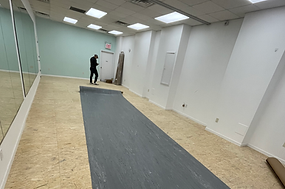
Creating the physical studio space was one of the most exciting parts of this process, but it was also one of the biggest learning experiences.
When you have a creative vision, it is easy to imagine exactly how you want something to look. You can see the finished studio in your head. You know where the mirrors should go, what the lobby should feel like, what colors you want, what kind of experience families should have when they walk through the door. Then you start getting quotes, talking to contractors, looking at materials, and realizing that the vision you have in your head has an actual price tag attached to it.
Working with a contractor taught me that communication is everything. You have to be clear about what you want, but you also have to understand that construction doesn't always go according to plan. Things take longer. Things cost money. Something you thought would be simple turns out to be much more complicated than you expected. Sometimes you thought you would get the fancy door only to turn around and reuse the ones that the space had before to save you a couple of hundred dollars. Reality does that.
I've had to learn how to prioritize and pivot. Some things are important enough to invest in now, while other things can wait until the business grows. Not being able to do everything immediately doesn't mean the vision is lost. Sometimes it just means the business has to grow into the vision, and that is ok.
4. At some point, you have to stop doing everything yourself. Uff, this one I am still in the process of accepting.
When you are starting a small business, doing everything yourself can feel like the only option and honestly I took pride in my “one-woman show”. There isn't always enough money to hire someone for every task, and there is a certain comfort in knowing that if you do it yourself, you know it will get done the way you want it. But eventually, doing everything yourself becomes one of the biggest limitations to your growth and your mental health.
There was a point where I realized that if I was teaching classes, responding to every email, managing registration, creating schedules, communicating with families, handling marketing, dealing with facilities, solving problems, and making every decision, I wasn't really building a business. I was building a job that required me to be everywhere at once.
Learning to delegate has been a process for me because I care deeply about the details. I care about retaining that authenticity that makes my studio so unique and special. I also care about not putting too much on my team’s shoulders so instead, I place all of the work on mine. But growing a business requires trust. It requires systems, communication, and people who can help carry the work with you. People who see my vision and genuinely care about seeing MSDA thrive as much as I do. I'm still working on this one but having the right people by my side has made this experience much easier and little by little we are creating roles in which my team can feel a sense of ownership in their work.
5. Your team is part of the product you are creating.
One of the things I've become much more aware of as I've grown these past two years is how important the people you hire are to the experience you are creating.
A dance teacher or front desk admin isn't simply filling a spot on a schedule. They are interacting with your students, communicating with families, and representing your studio when you're not in the room. Their energy, attitude, preparation, and ability to connect with students all become part of the experience families associate with your business. This has made hiring one of the things I think about most carefully. I want teachers who are strong educators, but I also want people who understand the kind of environment I am creating.
At the same time, I've had to learn that my team isn't going to care about the business in exactly the same way that I do, and that's okay. This is my business and my vision. I can't expect someone who works a few hours a week to carry the same emotional weight that I carry as the owner. What I can do is communicate the vision clearly, create a strong culture, and give people the tools and space they need to do their jobs well.
I am very much aware and in awe of the amazing work they do, the preparation it takes to show up at their best, and the care they show our students and families. I could never do this alone and I say it at every single event that we host with our families. I want them to know the hard work that our team does every week to make this program a success.
6. You can care deeply about the mission and still need to make money.
This has been a big mindset shift for me. Especially after signing that lease and being responsible for so many bills and expenses.
There is sometimes a strange expectation in the arts that if you truly love what you do, the financial side shouldn't be the most important thing. Of course, I didn't start a dance studio because I wanted to spend my days thinking about revenue and expenses. I started it because I believe in dance education and because I wanted to create something meaningful for children and families in my community. I wanted to provide a safe space for dancers to grow, learn, make mistakes, and know their teachers have their back - unconditionally.
But caring about the mission doesn't mean the business shouldn't make money. The rent still has to be paid. Teachers still need to be paid. Supplies need to be purchased. Insurance needs to be covered. The studio needs to be maintained.
If I want MSDA to exist ten or twenty years from now, the business needs to be financially sustainable. I've learned that profitability isn't the enemy of creativity. In many ways, it is what makes creativity possible. It brings peace of mind and allows room for all of the creative juices to exist without the sleepless nights of “how am I going to pay for x, y, and z this month?” This one is an ever evolving process but after our first two years, I can honestly say I am so close to achieving it.
7. Growing enrollment doesn't necessarily mean you're growing a profitable business.
This is another lesson that I wish someone had explained to me much earlier. Seeing more students in the studio feels like success, and it absolutely is something to celebrate. But enrollment alone doesn't tell you whether a program is financially healthy.
You can have a class that looks full and still have very little profit after paying the teacher, covering the space, accounting for administrative costs, and everything else that goes into running the program. You can add more classes and increase revenue while simultaneously increasing your expenses.
I've had to learn to look beyond, “How many students do we have?” and start asking, “What does this program actually contribute to the health of the business?”, “Is this class cutting into the profits of another class?”, and “Can this class be sustainable on its own?”
That has changed the way I think about scheduling, pricing, staffing, and growth. Sometimes the smartest business decision isn't adding another class. Sometimes it is making an existing program stronger or shutting down those that are bleeding us dry.
8. Being a Latina business owner has made me think differently about what I'm building.
I don't think I fully understood when I started how much of this journey would also be about learning to take up space and, in some cases, insisting that other people recognize that I belong in the room.
Being a Latina business owner in New York City has come with moments where I've felt underestimated or simply not taken as seriously as I should be. There have been plenty of situations where I am the person making the decision, yet someone will direct the conversation toward my husband or the next man in the room, instead of me. There have been moments where people seem surprised to find out that I own the studio, almost as if I don't quite look like what they imagine a business owner is supposed to look like. I can’t tell you how many times I have had a conversation with a parent, landlords, community members, and even other businesses, and I get the “when is the owner in today?” or the “wow, you don’t like you are old enough to own a business” or the big eyes when they realize it is me they need to be dealing with... so many weird interactions. And I'll be honest—those moments bother me to my core. If you know me, you know.
Not because I need everyone to know who I am or be impressed by what I've built, but because they have made me very aware of how quickly people can make assumptions about you based on what you look like, how you speak, or where they assume you fit in a room. I've had to learn not to shrink myself in those moments. I've had to become more comfortable saying, “I'm the owner of the business,” and giving them my big-ole cheesy smile.
That confidence didn't come overnight. When you're building something from the ground up, there are already enough moments where you question yourself without also wondering whether other people are questioning your credentials and abilities to lead.
But I think this experience has also made me more intentional about what I am building and who I want to see reflected in it. It has made me think about the young dancers who walk into my studio. I want them to see that there are many ways to build a career in dance. You can be a professional dancer, an educator, a choreographer, an arts administrator, or a studio owner (among many more). You can be creative and understand business. You can be an artist and a CEO.
And especially for my Latinx dancers, I want them to see that they don't have to fit someone else's idea of what a business owner, leader, or successful person is. I want them to walk into rooms knowing that they belong there because of their own merit and abilities. And I think, in many ways, I'm still learning that myself.
Being a Latina business owner in New York City has meant learning how to navigate spaces where I don't always see people who look like me. It has meant learning how to advocate for myself and my business, and sometimes having to remind myself, and others, that I don't need to apologize for being ambitious and going after my vision for this organization!
9. They tell you the numbers aren't something to be afraid of, but honestly, they scare me so much!
For a long time, I think I approached finances the way a lot of creatives do: I knew they were important, but I didn't necessarily want to spend too much time looking at them. Now I understand that the numbers are simply another way of telling the story of the business. Even when sometimes I don’t like the story it is telling… the harsh reality check! They tell me where we're growing, where we're spending too much, which programs are working, where we need to make changes, and what we can realistically afford to do next. The problem is wanting quick fixes when the stress kicks in when in reality the fix is the hard word that needs to be put in.
I don't always like what the numbers tell me. Sometimes they force me to make decisions I don't want to make and see things differently than what I thought it would be like by now. But I've learned that avoiding the numbers doesn't make the problem go away. It actually makes the problem grow bigger. If anything, understanding the finances has made me feel more empowered as a business owner. I don't need to be a CPA. I just need to understand enough to make informed decisions and know when I need to bring someone else in. Note to future business owners: get yourself a good CPA early in the game.
Growth happens slowly and steadily. Seeing the month to month or year to year progression has honestly been the fuel that drives me. I set goals based on my growth trends, I set expectations for enrollment, capacity, student and teacher retention. These things help me see where I am in my vision and keep me going!
10. I'm still learning, and I think that's actually the most healthy lesson of all.
Perhaps the biggest lesson I've learned is that there is not going to be a point where I suddenly feel like, Okay, I've finally figured this out! Every time I think I have something under control, the business grows and presents me with completely different problems. And I think that's part of entrepreneurship.
I'm still learning how to balance being the educator, the creative director, the employer, the business owner, and the person responsible for making sure the lights stay on. I'm still learning how to grow without growing too quickly, how to invest without putting the business in a difficult position, and how to build a team while maintaining the culture that made me want to open the studio in the first place. I also think there is something valuable about sharing the journey while you're still in it.
I didn’t want to write this from the perspective of someone who has “made it” and now has all the answers. I'm not there. I'm building a business in New York City, and every season brings something new to figure out. What I do know is that the version of me who signed that lease two years ago knew a lot less than the version of me sitting here in front of the computer today. I've learned how to negotiate, how to look at finances, how to manage a team, how to advocate for myself, how to make difficult decisions, and how to accept that not every part of the vision has to happen immediately.
Most importantly, I've learned that creativity and business don't have to exist on opposite sides of the table. For those of us who come from the working class, business can sometimes feel like the part we have to learn in addition to being artists and educators. But I'm starting to see it differently. The business is what allows the creative work to continue - to thrive!
The goal isn't simply to build a bigger studio or have more students. The goal is to build something sustainable - but something that can serve our communities, provide meaningful experiences for our dancers, and continue to exist long after the initial excitement of opening the doors has passed.
I'm still figuring out exactly what that looks like. For now, I'm learning to appreciate the process of building it and seeing what I am capable of!

Behind-the-scenes & memorable event photos captured by our team and my own family document pieces of MotionScoop’s journey over the past two years... from construction and our very first days in the studio to Open Houses, community events, and milestone celebrations. Each photo holds a little piece of the story: the work, the people, the memories, and the community that helped turn our studio into the space it is today.
- Mari Vasconez