
Maestrx
Musings:
Reflections from
Dance Teachers
in Practice

Dance friends Maria Hinojosa hugging Camila Zambrano
Photo Credit: Erika Hinojosa
Familia Folklórica
by Gabriela Mendoza-García, Ph.D.
Published March 2026
My dancers have just finished their final bow at our annual concert. They are dressed in their traditional outfits which are brightly colored. I am on stage with them, and we perform a rhythmic zapateado sequence as the curtain slowly closes in front of us. The music of the mariachi band slowly begins to fade. Once the curtain closes, we all turn to each other and cheer loudly, smile, and hug each other with congratulations. For we are a familia folklórica or a folklórico family.
I teach children and adults of all ages traditional Mexican folk dances or folklórico. These are dances passed on from one generation to the next over centuries. Dancers wear traditional garments of the time-period and dance using intricate percussive footwork movements called zapateado. Furthermore, I carry the bodily histories of my own dance teachers including Sanjuanita Martínez-Hunter, Roy Lozano, Pedro Serna, Michael Carmona, and Salvador Ibarra whenever I teach. My first dance teacher was my aunt, Sanjuanita Martínez-Hunter. She is my inspiration. I continue teaching in her footsteps, as I share the dances of our ancestors. I have taught folklórico for about thirty years now, founding the Texas A&M International Ballet Folklórico (TAMIU) and the TAMIU Ballet Folklórico Juvenil in 1996. Now, I have my own dance academy, and company called the Gabriela Mendoza-García Ballet Folklórico.
In my folklórico dance group, I have mothers and daughters dancing together; cousins; brothers and sisters; even entire families including parents. But something amazing happens when we all dance together, we all become a familia folklórica. I don’t know how or why this happens, but we feel this affection, affinity, or closeness with our dance friends. It could be because dancing folklórico is a team effort requiring everyone to work together in order to dance in unison. Perhaps it is because as dancers we learn to dance with partners that entails close communication. Maybe we become a familia folklórica because we learn detailed choreographic patterns involving quick thinking and collaboration. Somehow, I do not believe that these are the central reasons. I suggest that we become a familia folklórica because we are united in purpose.
As we dance folklórico we embody the histories of our ancestors’ telling stories of love, loss, triumphs, and survival. This is one common goal. This goal is so integral that we realize that everyone who dances folklórico has an important contribution to make. Sometimes we dance alongside people who may have a disability; someone much older or younger than us; or a person with a totally different outlook. But we learn to love the members of our familia folklórica despite our differences. Dancing folklórico with its emphasis on history, customs, and traditions reminds us that we are more alike than different because we have a common purpose—to continue passing on the dances to the next generation as our ancestors have done before us.
Yet, this is not the sole purpose of our dancing. We also dance folklórico for the sheer love of dance. We pay close attention to the music of our dances. Listening to the voices sung in lyrics, focusing on melodies played by the traditional beats of the jarana, guitarron, and bajo sexto. We proudly dress in traditional attire remembering how many layers of clothing our ancestors wore and the types of accessories that were once fashionable. Most importantly, zapateamos with strength, energy, precision, and skill that takes days, weeks, months, and years of rehearsal. We share this love of dance in common. This commonality helps resolve differences so that we can work together to perform at our best abilities. A love of dance underlies our every performance and bonds members of the familia folklórica.
The familia folklórica is inspired by a continuation of dance histories and united by a love of dance. Dancers deeply understand the important role they play in maintaining our dance history. This encourages us to see past differences and unite towards a common goal. Our love of dance underscores our every rehearsal and performance connecting us together in a common purpose. We dance to acknowledge, remember, inspire, and most of all we dance because we love it! Folklórico dancers are truly amazing!
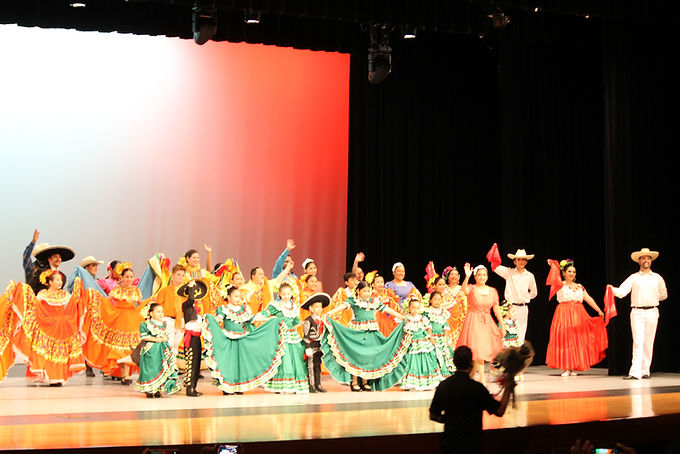
Dancers of the Gabriela Mendoza-Garcia Ballet Folklorico taking a final bow.
Photo Credit: Mike Zavala